
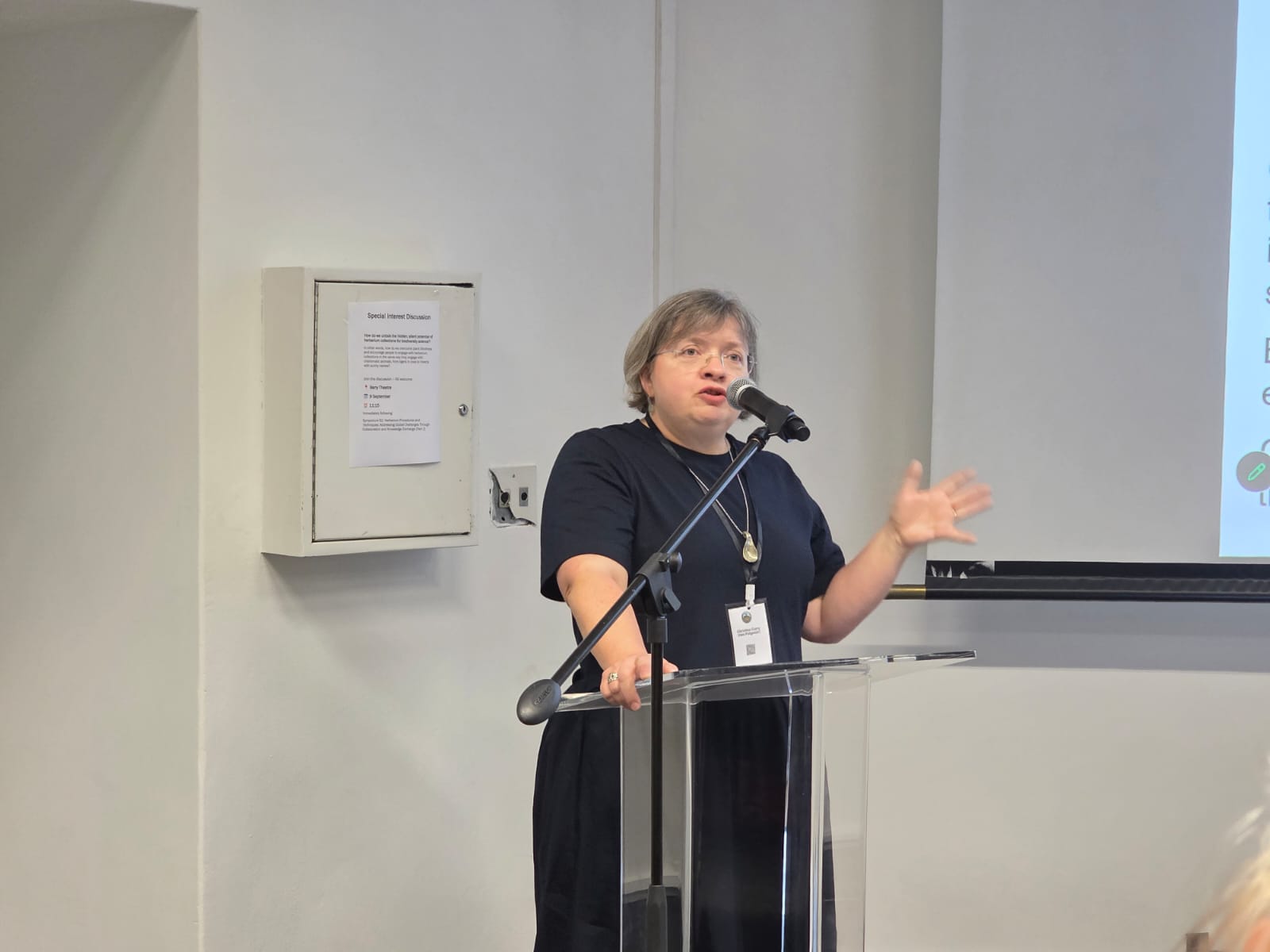
Christina Potgieter Curry presented at SPNHC 2026 on how the Bews Herbarium incorporated five neglected plant collections — and what other institutions can learn from the experience.
What happens to collections that lose their home?
Across South Africa, natural history collections sit in buildings that no longer have the funding, the staff, or the institutional will to look after them. A curator passes away. A university merges with another. A nature reserve loses its volunteers. The specimens remain — irreplaceable records of the country’s biodiversity — but the infrastructure to care for them does not.
These are orphan collections. They are not rare. And without intervention, they deteriorate.
At SPNHC 2026 in Cape Town, Christina Potgieter Curry of the Bews Herbarium at the University of KwaZulu-Natal presented “Lessons learnt from incorporating five ‘orphan collections’ at the Bews Herbarium (NU)” — a practical account of what it takes to give these collections a new home, and what the institution gained in return.
Five collections, eight years
Over the past eight years, the Bews Herbarium has incorporated five orphan collections, supported by the National Science Collections Facility (NSCF). The NSCF has facilitated the relocation of over 140,000 specimens across South Africa through 17 completed projects (with seven more underway), and the Bews Herbarium was involved in five of those.
The five collections that found a new home at Bews were:
- A conservation body’s collection, which became neglected after a curator’s premature death. Without anyone to maintain it, the specimens were deteriorating.
- Two university collections that came together as part of institutional restructuring. The University of Durban-Westville merged with the University of Natal to form the current University of KwaZulu-Natal, and collections from both campuses needed consolidation.
- A nature reserve herbarium in southern Pietermaritzburg, where volunteers had been running the collection but were moving away. The reserve needed an institution willing to take responsibility for the specimens.
- A university collection in the northern part of Pietermaritzburg, where the NSCF imaging team had documented the poor condition of the material and the institution acknowledged it lacked the capacity to maintain it separately.
Each came with its own challenges — different preservation states, different documentation standards, different taxonomic scopes. All required careful planning.
What the herbarium gained
The benefits extended beyond the collection itself. Collaboration with the University of KwaZulu-Natal strengthened. Students began training with the incorporated material. Researchers who had never visited the Bews Herbarium before started coming — drawn by collections that were previously invisible, stored in buildings where they rarely saw the light of day.
The increased scale also helped justify the herbarium’s institutional position. A larger, more representative collection is harder to ignore in discussions about research infrastructure.
The talk offered concrete guidance for institutions considering similar relocations — the kind of practical detail that is rarely published but essential to get right.
Start with the agreement
Before any specimens move, institutions need a clear legal framework. Christina recommended the 99-year loan agreement: long enough to be effectively permanent, short enough that institutions find it less daunting than a permanent transfer. The agreement should be signed at the institutional level — not between individuals — and should address what happens if either institution’s circumstances change.
Plan for space — and hold onto it
Space is always the constraint. The Bews Herbarium’s original designer had not accounted for air conditioning ducts, which meant a third tier of cabinets could be installed beneath them — creating unexpected extra capacity. A temporary holding room on the floor below, originally meant for boxes, was never relinquished once the boxes were gone. The lesson: when you secure space, keep it. Rearrange your existing collection to accommodate incoming material, and plan for future acquisitions at the same time.
Budget for the last 10 per cent
Processing times are easy to underestimate. Christina cautioned that the final fraction of any project takes disproportionately long — you inherit the material that the previous institution did not have time to deal with, the problem specimens, the undocumented backlog. Budget and plan accordingly.
Use contract staff for processing
Permanent staff should focus on planning, advice, and quality control. The day-to-day processing of incoming specimens — accessioning, mounting, filing — is best handled by contract workers who can maintain focus on the task without being pulled into other institutional responsibilities. This protects both the project timeline and the wellbeing of your permanent team.
Freeze incoming material
Pest management was one of Christina’s biggest concerns. Every incoming collection was frozen before being allowed near the existing collection. Some collections were frozen multiple times — an approach that may have been more cautious than necessary, but protected against the risk of introducing pests to 250,000 existing specimens. A general fumigation was also carried out as a precautionary measure.
Integrate physically, retain identity
The Bews Herbarium chose a middle path between full integration (re-barring everything under a single system) and keeping collections completely separate. Incoming specimens were placed in species folders marked with the original collection’s acronym, then inserted into existing genus folders. Original barcodes were retained. New barcodes, where needed, used the original collection’s prefix.
The result is a “one-stop shop”: visitors can find everything in one place, curators can manage it as a single collection, but the provenance of each specimen is preserved. If separation ever becomes necessary, it can be done without losing the information trail.
Check names before you file
Taxonomic nomenclature moves on. Many incoming collections had outdated names. Christina recommended checking and updating names as a distinct step during integration, not as an afterthought. This is time-consuming but essential — filing specimens under wrong names undermines their scientific value.
The unexpected benefits
Beyond the specimens themselves, the relocation process generated value that Christina had not anticipated. Collaboration with the University of KwaZulu-Natal deepened: students now train with the incorporated material, and the herbarium has regular contact with the institution in a way it did not before. Researchers from across South Africa have visited specifically to see collections that were previously inaccessible.
The herbarium also became a more geographically representative resource. With specimens covering a wider area, it serves a broader research community — and that visibility has made it a more attractive destination for visiting scientists, students, and collaborators.
A recommendation
Christina closed with a straightforward recommendation: if you have the time, the funding, and the institutional support, incorporating orphan collections is worth doing. It strengthens your collection, builds relationships with partner institutions, and — perhaps most importantly — ensures that irreplaceable specimens are not lost.
The NSCF provides funding, coordination, and practical support for these relocations. Institutions with collections in need of a new home, or herbaria willing to receive them, are encouraged to get in touch.
Christina Potgieter Curry is based at the Bews Herbarium, University of KwaZulu-Natal, Pietermaritzburg. Their presentation was delivered at SPNHC 2026 on 9 September 2026, in the Herbarium Procedures session at Barry Theater, Iziko South African Museum, Cape Town.
The Natural Science Collections Facility (NSCF) coordinates natural history collections across 19 partner institutions in South Africa. For more information, email info@nscf.org.za or follow @NSCF_ZA.