
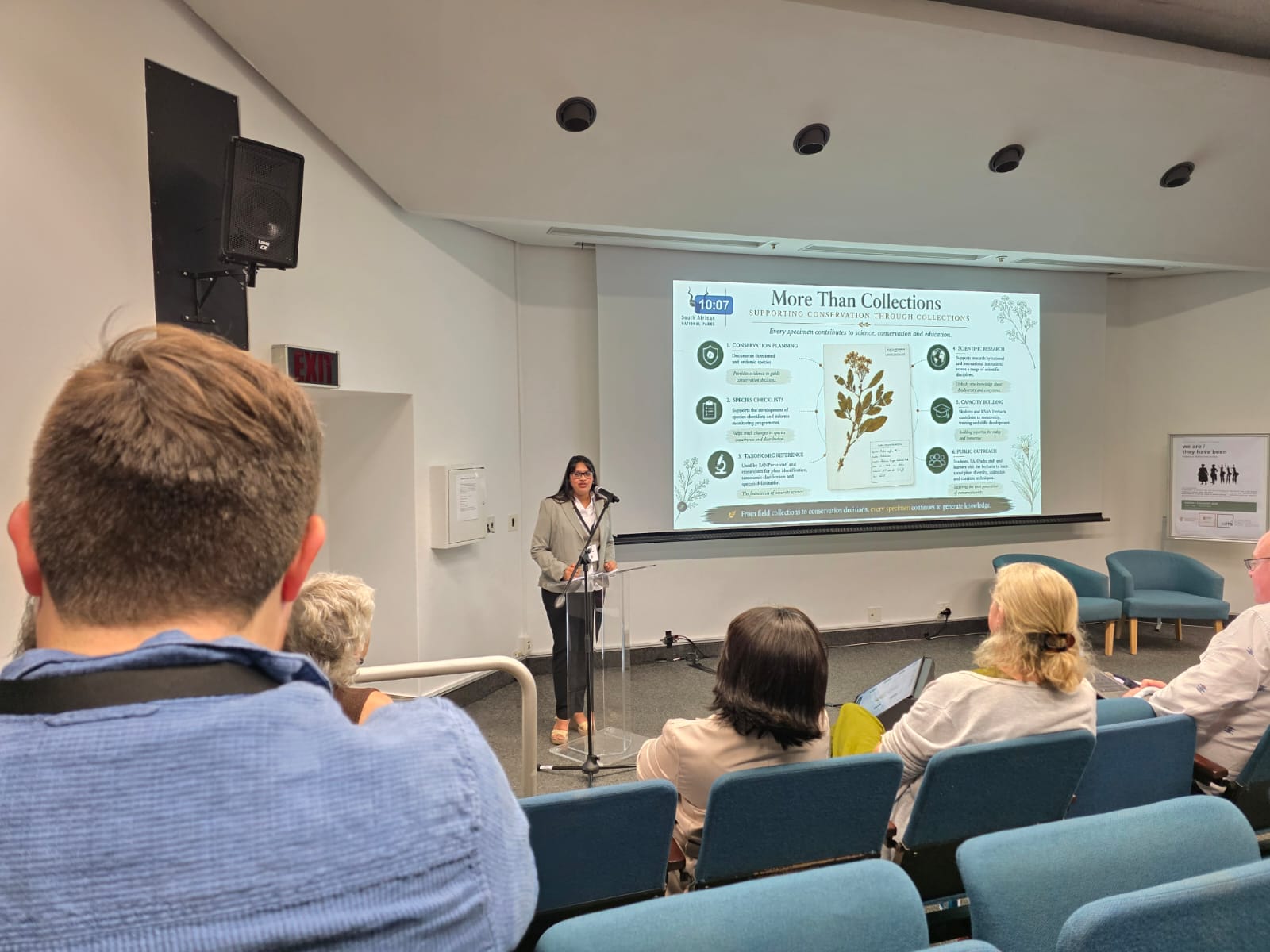
Nikisha Singh presented at SPNHC 2026 on how SANParks’ four herbaria, holding over 35,000 specimens across nine biomes, are being digitised and opened to the world.
A century of plant records, hidden in our national parks
Most visitors to South Africa’s national parks come for the wildlife. Few realise that the parks also hold a scientific treasure: four herbaria containing over 35,000 preserved plant specimens, collected over almost a century.
Globally, herbaria play an integral role not only in the conservation and taxonomy of plant species, but also in supporting ecological research, biodiversity assessments and environmental monitoring. They hold critical historical and spatial data, for new species descriptions, distribution records, checklists and long-term change detection.
At SPNHC 2026 in Cape Town, Nikisha Singh presented “Pressed for impact: Unleashing the potential of South African National Parks plant records”, the story of how these collections, part of the Natural Science Collections Facility (NSCF) network, are being digitised, standardised, and made available to researchers worldwide.
Four herbaria, nine biomes
SANParks manages three main herbaria and one active field herbarium, each representing a distinct part of South Africa’s botanical diversity:
- Skukuza Herbarium (Kruger National Park): approximately 16,000 specimens, representing the Savanna biome. Its oldest specimen, Nesaea crassicaulis, was collected in 1930. Curator: Nikisha Singh, Senior Biotechnician: Collections.
- Kimberley SANParks Herbarium (KSAN): 11,756 specimens, housing specimens from 15 other national parks — making it a uniquely broad reference across the parks network. Its oldest specimen, Tetrachne dregei, was collected in 1952. Curator: Dr Nthambeleni Munyai, plant-herbivore scientist.
- Garden Route National Park Herbarium: 3,450 specimens, representing forest and fynbos biomes. Its oldest specimen, Vernonia mespilifolia, was collected in 1923. Curator: Johan Baard.
- Richtersveld Desert Botanical Garden Field Herbarium: approximately 4,000 specimens, representing the Succulent Karoo biome. Its oldest specimen was collected in 1987. Curator: Pieter van Wyk.
Although the specimens were collected in very different parts of South Africa, they represent an important biodiversity resource for the country’s protected areas. Together, these collections span nine of South Africa’s biomes and almost 100 years of collecting.
The value of the collections
The collections have already contributed to management and conservation within the protected areas. The physical specimens act as identification references for researchers from South Africa and around the world, and the biological data associated with them has contributed to:
- Checklists of plant species
- Monitoring initiatives for species of conservation value
- Distribution maps
- Identification guides
- New species descriptions and taxonomic research
- Documentation of endemic, invasive and red-list plant species
The collections include numerous threatened, rare and alien taxa. Data from the herbaria have already contributed to peer-reviewed publications, from floristic inventories and species identifications to national checklists, plant distributions and invasion research, and inform the management of threatened and endemic species.
The collections also play an important educational role. Local university groups regularly visit the Skukuza Herbarium to learn plant pressing techniques and field collection methods, skills that feed directly into their coursework.
Research visits are a constant. One notable example: two researchers have been visiting the Skukuza Herbarium for the past decade to image specimens of tree species, and are developing a website and app that will allow users to identify specimens using diagnostic features.
The unglamorous work of data
As anyone who works with collections knows, data is captured differently by different people, at different times, using different methods. The result is inconsistency: dates in different formats, abbreviations in localities or collector names, GPS coordinate issues, or quarter-degree-square coordinates recorded instead of precise points.
Inputting and cleaning data is not the most glamorous aspect of collection work, but it is essential. Data that has not been standardised or quality-checked is of limited use, no matter how beautiful the digitised images.
A substantial amount of work has therefore gone into cleaning and standardising the Skukuza and KSAN datasets. Taxonomy has been updated using resources such as the South African National Plant Checklist and GBIF. As Nikisha put it: it is nice to have a beautiful digitised image, but if the information attached to the specimen is not of high quality, it is not of much value.
The digitisation journey
The Skukuza Herbarium digitisation initiative began in 2023, with a clear goal: develop a workflow to produce high-quality images that could be shared with researchers, so they would not have to travel all the way to the Kruger Park to determine whether a specimen would be useful to their research.
Standardising the workflow took time, but the results are now visible. The NSCF and SANParks, along with honorary rangers and volunteers, provided assistance with the programme and funding for equipment.
The milestones speak for themselves:
- 2022: The NSCF imaging team assisted with barcoding 16,000 herbarium specimens in a single week.
- Recently: 1,500 specimens were imaged at the Skukuza Herbarium, with NSCF support on imaging standards and training.
- Over the past year: The NSCF imaging team imaged all 11,000+ specimens at the KSAN Herbarium.
- Now: The Skukuza and KSAN datasets are available on GBIF, open source, downloadable, and usable by anyone.
Why it matters
Herbaria face real limitations: a shortage of taxonomic expertise, and physical specimens vulnerable to natural disasters, fires, floods and storage issues. As much as the information needs to be out there, it is not always readily accessible, or in the form that researchers need. Digitisation and open data are ways to mitigate these limitations.
Openly accessible data of this kind can help address conservation challenges, model species distributions, track invasive species, and inform biodiversity policy and planning. Continued investment in digitisation, curation and skills development, particularly through partnerships, is essential to fully realise the value of these collections.
As Nikisha concluded, not only SANParks’ herbaria but herbaria globally represent a vital biodiversity resource. It is up to the institutions that hold them to maintain the records and get the data out there, so that everything becomes valuable.
Nikisha Singh presented on behalf of SANParks at SPNHC 2026 on 9 September 2026, in the Herbarium Procedures and Techniques: Addressing Global Challenges session (Part 2) at Barry Theater, Iziko South African Museum, Cape Town. The talk was co-authored with seven colleagues.
The Natural Science Collections Facility (NSCF) coordinates natural history collections across 19 partner institutions in South Africa. Follow on social media @NSCF_ZA.
Communications Contact:
Fulufhelo Tambani
Specialist: Science Communication
f.gelebe@sanbi.org.za