

Assignments Submission:
Usisipho Sotshangane:u.sotshangane@sanbi.org.za and cc usisipho@nscf.org.za.

You can work as a team in your institution, or if this is not possible, then as an individual.
- Does your institution have an ethics policy?
If yes – highlight anything that is covered in the Manual in the Ethics chapter
Are there any gaps? What would need to be added for it to be in line with the Manual?
If no, draft an Ethics Policy, covering the main points that are in the Manual.
- For your policy or additions to the existing policy, what points do you think will meet the most resistance from a. managers, b. researchers and c. collection managers / curation staff?
- How would you go about changing an existing policy or getting a new policy adopted in your institution?

1. Assessment of the current status of collection documentation:
Complete the table provided – status report of documentation for your institution.
- Working individually or as a group:
Either:
- Draft a Collection Documentation Policy for your institution
OR
- Draft an overview of the collection that you work in / are responsible for. This should include the information listed in the Manual.
ASSIGNMENT 3: Develop a Risk Assessment Report for a clearly defined collection in your institution
Please use the attached template for the risk assessment assignment for the Collection Management & Curation Course.
The different steps in the risk assessment process are in separate worksheets in the Excel spreadsheet – see the bottom tabs (Background & Context, Stakeholders and role players, Risk Identification, Risk analysis and evaluation).
There will be aspects of the template that are not applicable to your particular collection that you are doing the assessment for. In such cases I suggest that you use NA or a ——- rather than just leaving the cell blank.
You can go to the document that this approach has been taken from to get more details – https://www.iccrom.org/sites/default/files/2017-12/risk_management_guide_english_web.pdf, and refer to the NSCF Manual.
- Describe the context of the collection and institution.
- Identify risks that are relevant for the focus collection, using the 10 agents of deterioration and the 6 layers of enclosure.
- Assess each risk – common or rare event or cumulative process, frequency or how long impact will take, how much of each specimen will be impacted, and how much of the collection will be impacted (Score of 1-5, use the scales provided).
- Total up the scores for the three criteria (A+B+C) to get the Magnitude of Risk and use the total score for each risk to classify it as Catastrophic, Extreme, Risk, Medium or Low
This assignment would be best done as a group within the institution, or across institutions with similar types of collections.
ASSIGNMENT 4: Develop a Risk Treatment Plan based on the identification and evaluation / analysis of the risks.
From the Risk Assessment that you did for the previous assignment, select the Catastrophic and Extreme Risks (3-5 risk max) and do a Risk Treatment Plan:
- Identify the risk mitigation options by layer of enclosure and stages of control for each of your 3-5 risks. Remember to identify all possible options.
- Then list all the mitigation / options for ONE risk in the template table and assess the percentage to which the option will remove or reduce the risk and estimate the cost of implementation.
- Select the best options for the risk, and develop an implementation plan for ONE of the options.
This assignment would be best done as a group within the institution, or across institutions with similar types of collections.

ASSIGNMENT 5: Emergency / Disaster Response Plans
Develop a Pocket Emergency / Disaster Response Plan for your institution. Use the template provided for the Plan. There is already information on the template, but you need to adapt it to your specific situation / collection type.
You also need to submit a short description of the process you followed to develop the Plan. This should give some background on whether you worked from an existing plan or started from scratch; if you worked from an existing plan, what you had to add or update; whether you worked as part of a team or individually; what information you got from relevant staff, and what information is your best estimate of what should be followed in the case where you were not able to get input from more senior staff / managers.
You can use the following steps as a guide for completing the Pocket Plan:
- Does your institution have an Emergency / Disaster Response Plan?
- If yes, review it to see what it says about the collections.
- If the existing Plan does cover collections, then use it to produce a Pocket Emergency / Disaster Response Plan. You might need to identify gaps or outdated information and update this.
- If the existing Emergency / Disaster Response Plan only covers other aspects of the institution, it may still be useful, but you will need to gather a lot more information to develop the Plan for the collections.
- If there is no Emergency or Disaster Response Plan, then you will need gather all the relevant information.
Some points to consider:
- It will probably not be acceptable to submit your assignment showing staff cell phone numbers or email addresses on the Pocket Plan. You can redact / replace these with symbols.
- You can develop the full plan – this could be very useful if your institution does not have one. You are only required to submit the Pocket Plan for the Assignment.
- This Assignment would be best done as a group, involving the relevant staff in your institution. We accept that this may not be possible and so it is acceptable to work on the Assignment individually. For the official institutional Plan, however, it is critical to involve the relevant staff.
- If there is information that you are unsure about, and you are not able to get input from more senior staff in your institution, then it is acceptable to think about what you think could work (eg. for the decision-making, authorisation, chain of command during an emergency / after a disaster).
You will also find lots of very useful resources at the following site:
https://www.connectingtocollections.org/archiveresponseplan/
Specifically, look at the way they suggest developing the different requirements (at the bottom of the webpage in the green block):
Web Resources:
- Writing a Disaster Response Plan Resource List (doc, 64 KB)
Disaster Plan Template Downloads:
- PReP™ Template (doc, 63 KB)
- Immediate Emergency Response (doc, 42 KB)
- Facilities: Locations of Emergency Systems (doc, 38 KB)
- Disaster Response/Recovery Team (doc, 38 KB)
- Responsibilities During a Disaster Response & Recovery (doc, 68 KB)
- Field Guide Assessment Form (pdf, 94 KB)
- Salvage Priorities – Collections (doc, 96 KB)
- Inventory Control List (doc, 75 KB)
- Disaster Response Supplies/Equipment (xls, 76 KB)
- Salvage at a Glance (doc, 184 KB)
- Salvage of Water Damaged Collections (doc, 144 KB)
Drying Techniques for Water Damaged Books and Paper (doc, 39 KB)

ASSIGNMENT 6: Health & Safety Assessment
- Carry out a health and safety risk assessment for the collection area in which you work. This should cover all health and safety hazards associated with the collections and can also include field work if you or other staff do field work to expand the collection. In the same way that we scored the risks to the collection, we can also score the risks to people’s health and safety so that the hazards that are most likely to occur, and that are most harmful are the ones that are focussed on for mitigation.
- Once you have identified the health and safety hazards for staff and visitors using or working in the collection area or collecting material for the collection, develop a mitigation plan to remove or reduce each hazard.
Guidelines
Step 1: Identify the Hazards
You can use the table below as a template for the hazards or use another template if your organisation has one.
Step 2: Assess the hazards / risks
Use the table for likelihood and the table for consequences and then the matrix to assess whether hazards are low, medium, high or extreme.
Step 3: Mitigation plan to remove hazards or reduce impact
What steps should be taken to mitigate the medium, high and extreme health and safety risks? You can think of all possibilities, and then identify those that are reasonable, and those that may be outside of budget, capacity of your institution.
You can use the Hierarchy of Controls that SAIAB showed us as your framework for the mitigation plan.
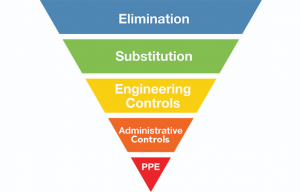
Step 4: Assess feasibility of the mitigation actions.
Which of these actions could be reasonably implemented in your institution given your current circumstances?

ASSIGNMENT 8: COLLECTION CARE POLICY
For this assignment you are required to do the following:
- Check whether your institution has a Collection Care or Curation Policy.
- If there is no specific collection care policy, check other policies on collection management / curation / care.
If your institution does have a relevant policy or policies, complete the table provided to review their content. Remember that a policy statement does not need to give the specific standards – it can refer to a standards document.
Complete the table in the template and answer the following questions:
- What policy statements need to be added to the policy to ensure that all the main points covered in the Manual are covered?
- Are there any other changes that need to be made to improve the policy for collection care?
If you have no policies that deal with collection care / curation, then you need to draft one for your institution / unit.
You can use the guideline points and the points covered in the webinar to draft the policy. Remember to consider whether the particular point is relevant to your institution / collections before including it.
Remember to include the following at the beginning of the policy:
- Who is the Policy applicable to?
- Roles and responsibilities – who is responsible overall for policy implementation / compliance? Who is responsible for other activities covered by the Policy?
- Review – when is it up for review?
- Authorisation – who approves / authorises/ signs off on the Policy?
Additional questions for everyone to answer:
Whether you are reviewing an existing policy or drafting a new one, getting the new policy approved and then implemented would be necessary for it to have any value.
- What process would you follow to get the new or revised policy approved?
- What steps would you suggest are taken to ensure that the policy is implemented?

ASSIGNMENT 9: COLLECTION STORAGE AND COLLECTION ORGANISATION
For this assignment there are two options but only one of these needs to be completed.
Option 1: Assessment of the current storage for a collection
The purpose of this assignment is to assess the storage structures or consumables in terms of whether they meet the required standard. This exercise would allow a collection manager or curator to determine what the needs are for upgrading a collection to meet global standards of collection care and to submit a motivation to management. It would also allow those responsible for a collection to understand where the weaknesses are in the storage materials and what needs special attention if upgrades are not made.
A template has been provided in Excel that shows the 10 agents of deterioration, from which collection objects should be protected, and the 5 layers of enclosure which are where the protection can be implemented.
- Complete the template to describe the current storage equipment / consumables for one collection.
- Use colour coding to show which storage equipment or consumables meet the standards and a different colour to show those that do not meet the standards.
There is information on the template that summarises the standards but more information can be obtained from the NSCF Collection Management & Curation Manual.
Option 2: Description of the organisation of a collection
Describe how the collection is organised.
- Building – is the whole collection in one building?
- Room – which room/s? if more than one how is the collection split?
- Shelving / cabinets – how are these arranged and numbered?
- How are specimens arranged? If this is by a hierarchical taxonomic system, what is the source of the taxonomy? How are specimens arranged within a species? How are unidentified specimens arranged?
- You can include layout drawings, taxon tables – anything that would explain to others how the collection is organised.
There is no template for this option.
ASSIGNMENT 10: WET COLLECTION CARE ASSESSMENT
This assignment involves a comprehensive assessment of the current state of care for a wet collection and will allow the identification of what aspects need attention, and what consumables or infrastructure is needed. It will allow a complete plan to be developed for addressing any problems or gaps in the curation of a wet collection.
It will probably be most practical for the purposes of the assignment to focus on a single, well defined collection.
Note that this assignment is only appropriate for those course participants who have a wet collection that they are involved in managing or caring for.
The assignment requires the filling in of the Excel spreadsheet template for the defined collection.
Some of the points on the template overlap with the template for Assignment 9 so the same data can be used, but there are additional details required for Assignment 10.
All blocks of the template should be completed. You can use “uncertain”, “approximately” or “not applicable” if necessary but the more accurate and complete the better.

ASSIGNMENT 11: DRY COLLECTION CARE
There is a choice for Assignment 11.
Option 1: Assessment of the current state of care for a dry collection
This assignment involves a comprehensive assessment of the current state of care for a dry collection and will allow the identification of what aspects need attention, and what consumables or infrastructure is needed. It will allow a complete plan to be developed for addressing any problems or gaps in the curation of a dry collection.
It will probably be most practical for the purposes of the assignment to focus on a single, well defined collection.
Note that this assignment is only appropriate for those course participants who have a dry collection that they are involved in managing or caring for. This can be a pinned insect collection, herbarium collection, mammal or bird skins, mollusc shells, bones or skulls.
The assignment requires the filling in of the Excel spreadsheet template for the defined collection.
Some of the points on the template overlap with the template for Assignment 9 so the same data can be used, but there are additional details required for Assignment 11.
All blocks of the template should be completed. You can use “uncertain”, “approximately” or “not applicable” if necessary but the more accurate and complete the better.
OR
Option 2: Development of an Integrated Pest Management Plan for a dry collection
For this option you can use resources such as the NSCF Collection Management & Conservation Manual or online information as a guide for the plan. Your plan must be for a specific collection and provide details relevant to that collection. You can use a table in Word or an Excel spreadsheet for your Plan but it should include the following sections:
- Preventing access to the collection by pests (determine how pests enter the building and put in place mechanisms to stop pests entering through these routes; identifying places where pests breed and hide and put in place actions to reduce / remove these risks).
- Monitoring pests – how will this be done? Identification of pests that are found – how will this be done?
- Elimination – how will you deal with any infestations that happen in the collection?
- Training and communication about the IPM Plan.
- Documentation – what forms and other documents are needed for the implementation of the IPM Plan?
Some useful resources:
https://manual.museum.wa.gov.au/integrated-pest-management
https://mvzhandbook.berkeley.edu/wp-content/uploads/sites/46/2020/02/Curatorial_IPMProgram.pdf – this is a very good example of an IPM Plan. It covers several collections – your assignment only needs to cover one collection so it won’t be a long as this document.
ASSIGNMENT 12: ACCESSIONING AND DEACCESSIONING OF SPECIMENS/COLLECTIONS
There is a choice for Assignment 12.
Option 1: Develop workflows for accessioning and for deaccessioning of specimens for your collection
This assignment requires two separate workflows to be developed. The workflows should indicate each step involved in the process, and the person responsible (their post and name if you wish) and the time frames for each step (how long should it take?).
OR
Option 2: Development of an accessions policy and standards document for your institution.
The policy and standards documents should cover at least the following points:
- The taxa that you will accept
- The type of materials that will be accepted
- Whether duplicates will be accepted and how many?
- What are the standards for the condition of the specimens?
- Whether specimen details must be captured into a spreadsheet or database by the donor
- Whether specimens must have labels with all details or whether just a code lined to a spreadsheet is acceptable
- Whether unsorted / mixed samples will be accepted
- What documents must be provided by the donor
- Whether specimens / collections without permits will be accepted and what you will do if there are no permits
- How an assessment will be done to determine whether the institution has the resources to fully care for the collection / specimens.
- The donation and any other forms that must be signed and what the conditions of donation are
- What the recording requirements are for collections / specimens coming in to the institution
It is recommended that a short policy document be developed separately from the standards document. The policy document will include the high level “rules” while the standards document will include the details of the specifications for the different aspects.

ASSIGNMENT 13: ACCESS TO COLLECTIONS AND DATA
There is a choice for Assignment 13.
Option 1: Develop any two workflows related to access
This assignment requires two separate workflows to be developed. The workflows should indicate each step involved in the process, and the person responsible (their post and name if you wish) and the time frames for each step (how long should it take?). The workflows can be for any aspect of visitors, loans, data, image or tissue sample access.
OR
Option 2: Review of existing documents in your institution for access.
This option requires that a list of documents required for access, covering general access policy, visitors, loans, data, images and tissue samples be drawn up using the Manual (see the appendix for a list), and that this list is used in a table, that assesses the following which documents exist and are implemented, which ones exist but require revision, which ones exist and are fine but are not implemented, and which ones have not yet been developed. An action column should also be completed, stating what actions are needed to address the gap/s for each document.
| Document type (Policy / standard / procedure / workflow / form / regsiter | Document content / topic | Current status of document | Current status of implementation | Actions needed |

ASSIGNMENT 14: COLLECTION MANAGEMENT & CURATION PLANNING
This assignment requires a collection management and curation plan for a single, well- defined collection.
The focus of the plan for the assignment is to plan to address risks to the collection, using the 10 agents of deterioration or destruction as the guideline. The assignment does not require that you address documentation (policies, SOPs, workflows and standards documents), health and safety hazards for staff and visitors or disaster management but these aspects would need attention in a full plan and you can include them if you wish.
Assignment 10 (wet collections) and 11 (dry collections) include a full assessment of the risks and what is needed to address them. These assignments will provide the information that you need for the plan, but you can also look at Assignment 9, which covered risks more broadly.
A template for Assignment 14 is provided. Guidance for how to complete the template is in red text.
Follow these steps:
- Identify which collection you are developing the plan for. Make sure that you include details about the staffing – how many staff and how much of their time is available to care for the collection (% or number of days or weeks or months).
- Pull out assignment 10 or 11 to identify the risks that need attention. If you have not done these assignments yet you will probably need to do one of them, depending on which collection you have selected for your plan (wet or dry). You can copy and paste your assignment onto worksheet 1 of the Excel spreadsheet template. You can delete the worksheet that is not relevant to your collection (either the wet or dry collection). Check assignment 9 and see if there is anything that needs to be addressed that is not covered by assignment 10 or 11.
- There are some additional items that need to be considered and that have been added to the worksheets in the template:
– organisation of the collection – is any major re-organisation required (to provide space for expansion / absorbing of an orphan collection or because the collection is not organised according to the proper system)?
– backlogs in accessions – historical or recent backlogs. How many specimens are there? What needs to happen to them (data capture, recorded in hardcopy inventory, preparation / sorting, identification, integration into the collection?)
– specimen data capture and quality control or other data management plans.
- Assessment: focus on the column headed “Needs – what needs to be done to meet standards” or other headings for actions needed.
- Pull all the activities / interventions identified as needing to be done into the second worksheet in the template (3-year plan) and put them under the appropriate objective.
- Next identify whether what needs to be done is a once-off intervention or a routine, ongoing action; what the target is; how much time it will take and what equipment or consumables and staff time (total person days) will be needed. These don’t have to be accurate – just an estimate is fine. If a very large storeroom needs full climate control it is likely to cost >R5 million. If you have 500 000 specimens to add to the database, work on a capture rate of 80 specimens / day / person – so one person working full time will take 28 years to complete the task; if you have 10 people then it will take about 3 years. If you need to rebottle 500 specimens, you need 500 glass bottles at an average of about R30/ jar – R15000, + ethanol at about R50 / l x 200l = R10 000; 1 staff doing the work – can probably do 30 bottles / day, so it will take about 1 month.
- Then assess whether the action is essential to achieving the objective – if you don’t carry out the action can you still achieve the objective? If not, then its essential. If you can partly achieve the objective without it then is moderately important, and it is makes no difference its not critical.
- Next consider the time and the costs – for example if your annual budget for all the collections is R150 000 a year, do you think you will get R5 million for climate control? You might have to consider not doing something if its just not feasible – but you might need to relook at your objectives.
- Then assess which actions are critical and feasible. If an action is critical and could be done but will require assistance from staff outside your collection and a bit more budget then it should be selected. Only if a critical action has no chance of ever being done with the budget and staff then don’t select it.
- Move the selected actions (those that were scored 1, 2 or 3) to the Annual plan List these under the objectives. You only need to do the plan for one year but normally you would include details for each year.
- Set the target for each action for Year 1. Add the staff who will be involved and how much of their time will be needed.
- Add the equipment and consumables needed and the estimated cost.
- The next step is to add up the estimated total number of people days needed to implement the activities, and the total budget needed for the year. These totals will give you an idea about whether you will be able to implement all the actions or if you need to reduce targets or remove some, or if you can increase targets for some.
- The final step would be to draw up a list of staff and the responsibilities they have been assigned and the time needed but you don’t need to complete this step.